
Iraq’s automotive market is shifting toward electric vehicles amid fuel subsidy reforms and government modernization goals. Importing a complete EV production line from China offers Iraqi manufacturers 30-40% cost savings, 12-18 month delivery timelines, and turnkey EPC solutions. This guide covers the four core production modules, import procedures, compliance requirements, and how partners like CAUTO(China Automotive Global Supply Chain Co.,Limited) streamline factory establishment from layout design to commissioning.
Introduction: Why Iraq Needs Local EV Manufacturing Now
Iraq’s automotive landscape is undergoing a structural transformation. With fuel subsidies under review and the government pushing for economic diversification beyond oil, electric mobility has emerged as a strategic priority. Baghdad’s recent policy signals — including reduced import tariffs on EV components and interest in local assembly partnerships — have created a window for industrial investors.
For Iraqi entrepreneurs, government-backed industrial zones, and regional automotive groups, the fastest path to capturing this opportunity is importing a complete EV production line from China. China dominates 60% of global EV manufacturing equipment supply, offering mature battery integration know-how, proven turnkey solutions, and pricing that undercuts European alternatives by significant margins.
CAUTO specializes in bridging this gap for emerging markets, providing end-to-end project management that adapts Chinese production line technology to local Iraqi conditions — from 45°C summer operating environments to workforce training programs conducted in Arabic.
What Is a Complete EV Production Line?
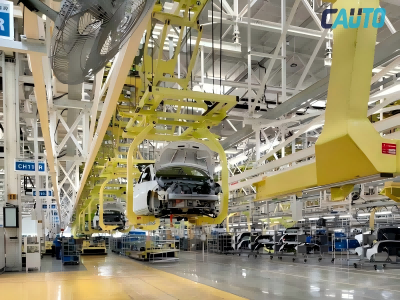
A turnkey EV production line consists of four interconnected modules, each critical to vehicle output quality and volume:
1. Stamping & Body-in-White (BIW)
Hydraulic press lines shape steel and aluminum panels into chassis components, doors, and hoods. Modern Chinese systems handle 250–300 tons with robotic feeding, achieving precision within ±0.1mm. For Iraqi operations, CAUTO recommends corrosion-resistant material handling systems given regional humidity and dust exposure.
2. Welding & Assembly Automation
This is the most labor-intensive phase. Chinese welding lines integrate KUKA or domestic-brand articulated robots with spot welding, laser welding, and adhesive bonding stations. A standard configuration delivers 15–30 JPH (jobs per hour) for compact EV platforms, scalable to 60 JPH for high-volume models.
3. Painting & Coating (Paint Shop)
Dürr-compatible spray robots and electrocoating (e-coat) systems form the core. Chinese paint shop suppliers now match European quality at 40% lower capital expenditure. Critical for Iraq: advanced dust filtration and temperature-controlled curing ovens to maintain finish quality in variable climates.
4. Final Assembly, Battery Integration & EOL Testing
The marriage station joins the painted body with the battery pack, motor, and interior components. End-of-line (EOL) testing includes dynamometer checks, ADAS calibration, and waterproof testing. Chinese lines support both CKD (completely knocked down) and SKD (semi-knocked down) configurations — ideal for Iraq’s phased localization strategy.
Why Source from China in 2026?
| Factor | China | Europe | Japan |
|---|---|---|---|
| Total Line Cost (Compact EV) | $8–15M | $18–30M | $20–35M |
| Delivery Lead Time | 12–18 months | 24–36 months | 20–30 months |
| Customization Flexibility | High (modular design) | Medium | Low (standardized) |
| Battery Tech Integration | Native (CATL, BYD supply chain) | Outsourced | Outsourced |
| After-Sales Support in MENA | Expanding (local offices) | Limited | Limited |
| Spare Parts Availability | 2–4 weeks | 6–12 weeks | 8–16 weeks |
Source: Industry estimates based on 2024–2025 turnkey project data.
China’s advantage extends beyond price. The country’s EV ecosystem — spanning battery cell production, motor manufacturing, BMS software, and charging infrastructure — means production line suppliers understand end-to-end vehicle integration natively. For Iraqi buyers, this translates to fewer compatibility issues and faster troubleshooting.
CAUTO leverages this ecosystem by pre-qualifying Chinese equipment suppliers and managing quality assurance protocols that align with Iraqi industrial standards, reducing buyer risk in a market where direct factory relationships can be challenging to establish.
Step-by-Step Import Process for Iraq
1: Technical Consultation & Factory Layout Design (Weeks 1–4)
Begin with a feasibility study covering target vehicle class (compact EV, electric SUV, or commercial van), annual production volume (5,000 vs. 50,000 units), and local content requirements. CAUTO conducts site surveys in Iraqi industrial zones — including Baghdad’s Bismaya New City and Basra’s planned manufacturing corridor — to assess power supply stability, water access, and logistics connectivity.
Deliverables: 3D factory layout, JPH calculation, utility requirements, and initial equipment list.
2: Equipment Selection & Contracting (Weeks 5–12)
Select line configuration based on budget and localization goals. Key decisions:
- Automation level: Semi-automatic (lower CAPEX, higher labor) vs. full robotic (higher CAPEX, lower OPEX)
- CKD vs. SKD vs. OEM: CKD kits for initial assembly; SKD for partial welding/painting localization; full OEM for complete manufacturing
- Quality standards: ISO 9001 baseline, with IATF 16949 upgrade path
Contracts should specify Incoterms (typically FOB Shanghai/Tianjin or CIF Umm Qasr), payment milestones (30% advance, 60% pre-shipment, 10% commissioning completion), and performance guarantees (JPH achievement, defect rate thresholds).
3: Shipping, Customs & Clearance (Months 4–6)
EV production line equipment ships via breakbulk or containerized cargo to Umm Qasr Port. HS codes to note:
- 8452.21 (automated welding machines)
- 8424.89 (spray painting robots)
- 9031.80 (vehicle testing equipment)
Iraqi customs require:
- Commercial invoice and packing list
- Certificate of origin (China Chamber of International Commerce)
- Technical specification documents (Arabic translation recommended)
- Import license from the Iraqi Ministry of Industry and Minerals
CAUTO coordinates freight forwarding and customs brokerage, ensuring equipment clears within 14–21 days of port arrival.
4: Installation, Commissioning & Training (Months 7–12)
Chinese technicians supervise installation over 8–12 weeks. Concurrently, CAUTO manages local workforce training — typically 40–60 Iraqi engineers and technicians across welding, painting, and assembly stations. Training modules include:
- Robot programming and maintenance (KUKA/Domestic brands)
- Quality control protocols and SPC (statistical process control)
- Safety standards (lockout/tagout, confined space entry)
- Battery handling and thermal runaway prevention
Commissioning concludes with a 30-day production trial: 50 units/day target for compact EV lines, with 98.5% first-pass yield.
Key Considerations & Compliance for Iraq
Regulatory Environment
Iraq lacks a unified automotive type-approval system, but the Central Organization for Standardization and Quality Control (COSQC) is developing EV-specific standards. Proactive compliance with UNECE R100 (battery safety) and R94/R95 (crashworthiness) positions manufacturers for future regulatory alignment.
Infrastructure Realities
Iraq’s grid stability varies by region. Production lines require:
- UPS systems for control electronics (minimum 30-minute backup)
- Voltage stabilizers (380V ±10% tolerance)
- On-site transformer capacity assessment
Water treatment for paint shop operations is non-negotiable; closed-loop recycling systems reduce freshwater dependency by 70%.
Workforce Development
Iraq’s technical education system produces capable mechanical engineers, but EV-specific skills — battery pack assembly, BMS diagnostics, high-voltage safety — require supplemental training. CAUTO structures 6-month apprenticeship programs pairing Chinese specialists with Iraqi technicians to build sustainable operational capability.
Supply Chain Localization
Phase 1 operations rely on Chinese CKD kits. Phase 2 targets should include:
- Local stamping of non-structural panels
- Domestic wire harness assembly
- Regional battery pack integration (partnering with CATL or BYD MENA distributors)
This phased approach reduces foreign exchange exposure and aligns with Iraq’s industrial employment goals.
Frequently Asked Questions (FAQ)
Q1: What is the total investment required for an EV production line in Iraq?
A compact EV assembly line (CKD/SKD) ranges from $8–15 million depending on automation level and annual capacity (5,000–30,000 units). Full OEM manufacturing with stamping, painting, and complete body-in-white capabilities requires $25–40 million. Additional costs include factory construction, utility infrastructure, and initial working capital for parts inventory.
Q2: How long does it take to import and commission an EV production line from China to Iraq?
The complete timeline from contract signing to production trial is 12–18 months. This breaks down into: 3 months for technical design and contracting, 4–6 months for equipment manufacturing and ocean shipping to Umm Qasr Port, and 4–6 months for on-site installation, commissioning, and workforce training. Delays can occur if import licenses from the Iraqi Ministry of Industry and Minerals are pending.
Q3: What are the main HS codes for importing EV production equipment into Iraq?
Key HS codes include 8452.21 for automated welding machines, 8424.89 for spray painting robots, and 9031.80 for vehicle testing and inspection equipment. Iraqi customs also require a commercial invoice, packing list, certificate of origin from the China Chamber of International Commerce, and technical specification documents with Arabic translation. An import license from the Ministry of Industry and Minerals is mandatory for industrial machinery.
Q4: Can Iraqi workers operate and maintain Chinese EV production equipment?
Yes, with structured training programs. Chinese equipment suppliers typically provide 8–12 weeks of on-site installation supervision and basic operator training. Partners like CAUTO extend this with comprehensive 6-month apprenticeship programs covering robot programming and maintenance, battery handling safety, statistical process control (SPC), and high-voltage electrical protocols. Iraqi mechanical engineers and technicians adapt well, particularly with Arabic-language training materials and hands-on mentorship.
Q5: What is the difference between CKD, SKD, and full OEM production lines?
CKD (Completely Knocked Down) involves importing all vehicle components — body panels, chassis, battery packs, interiors — for pure local assembly. This requires the lowest investment ($8–12M) but offers minimal local value addition. SKD (Semi-Knocked Down) includes partial localization such as welding sub-assemblies or painting bodies locally, requiring moderate investment ($12–20M). Full OEM manufacturing covers stamping raw steel, complete robotic welding, full paint shop operations, and final assembly from scratch, requiring $25–40M but maximizing local employment and supply chain development. Most Iraqi entrants begin with CKD and scale toward SKD or OEM over 3–5 years.
Conclusion
For Iraqi industrial investors and automotive entrepreneurs, 2026 represents a strategic entry point into electric vehicle manufacturing. China’s mature EV production line ecosystem — combined with competitive pricing, proven turnkey delivery, and native battery technology integration — offers the most viable path to establishing local capacity.
Success depends on meticulous planning: accurate volume forecasting, realistic infrastructure investment, and partnerships that bridge the technical and cultural gaps between Chinese manufacturing expertise and Iraqi operational realities.
CAUTO delivers exactly this bridge — from initial feasibility analysis through commissioning and workforce training — enabling Iraqi manufacturers to transition from importer to producer in the global EV revolution.
Ready to explore your EV production line project? Contact CAUTO for a free factory feasibility assessment tailored to Iraq’s industrial zones and regulatory environment.
Primary Keywords: import EV production line from China, electric vehicle assembly line, automotive welding line China, EV paint shop equipment, turnkey car factory China, CKD SKD production line