
Why Iran Is a Strategic Market for Automotive Production Lines
Iran represents one of the most compelling opportunities in the Middle East for automotive manufacturing investment. With a population exceeding 87 million, strong domestic vehicle demand, and an established industrial base centered around Tehran, Isfahan, and Tabriz, Iran has the foundation to become a regional automotive production hub. However, years of limited technology transfer and restricted access to European equipment have created a significant gap — one that Chinese automotive production line manufacturers are now filling.
From complete body welding lines and robotic painting booths to final assembly conveyors and end-of-line inspection systems, China now offers turn-key automotive manufacturing solutions at 40–60% of European costs, with faster delivery timelines and full technical training. For Iranian industrial groups, private investors, and government-backed manufacturing zones, importing production equipment from China is no longer just an alternative — it is the optimal path to modernizing domestic vehicle assembly capacity.
At CAUTO Global (China Automotive Global Supply Chain Co., Limited), we specialize in sourcing, integrating, and exporting complete automotive production line solutions from China’s top-tier equipment manufacturers to Iranian clients. Whether you are establishing a new CKD assembly plant or upgrading an existing facility to full SKD capability, we manage the entire export chain from factory audit to port delivery in Bandar Abbas.
Iran Automotive Market Overview
Domestic Production Landscape
Iran’s automotive industry is the second-largest in the Middle East, historically producing over 1 million vehicles annually through manufacturers such as Iran Khodro (IKCO) and SAIPA. While production volumes have fluctuated due to supply chain constraints, domestic demand remains robust, with significant unmet need for affordable passenger cars, commercial vans, and pickup trucks.
Government Policy Direction
The Iranian government has actively promoted local content development and technology transfer through:
- Import substitution incentives for locally assembled vehicles
- Free Trade Zone benefits in Chabahar, Kish, and Qeshm for manufacturing investments
- Joint venture frameworks encouraging foreign equipment suppliers to partner with Iranian industrial groups
The Equipment Gap
Sanctions and currency restrictions have limited Iranian manufacturers’ access to German, Italian, and Japanese production line suppliers. This has created a critical demand for high-quality, cost-effective alternatives — precisely what Chinese automotive equipment manufacturers now provide.
Types of Automotive Production Lines Exported to Iran
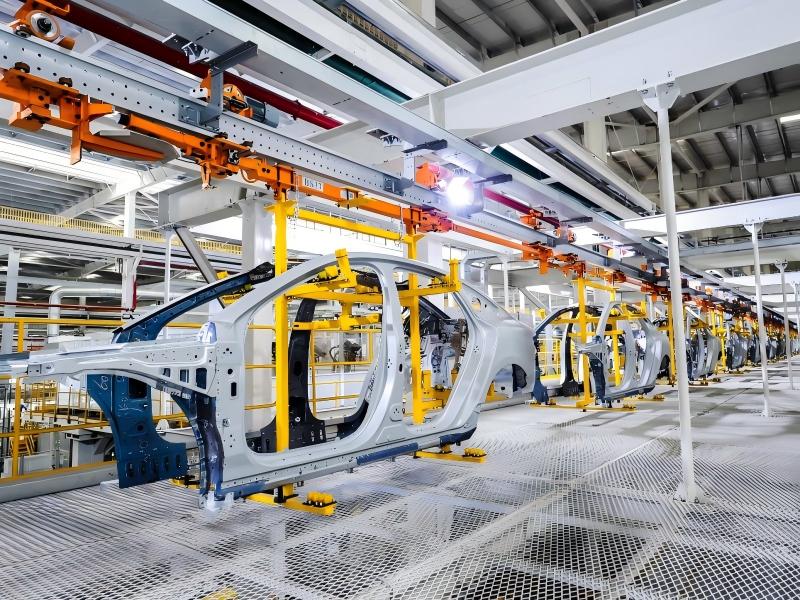
1. Body Welding Line
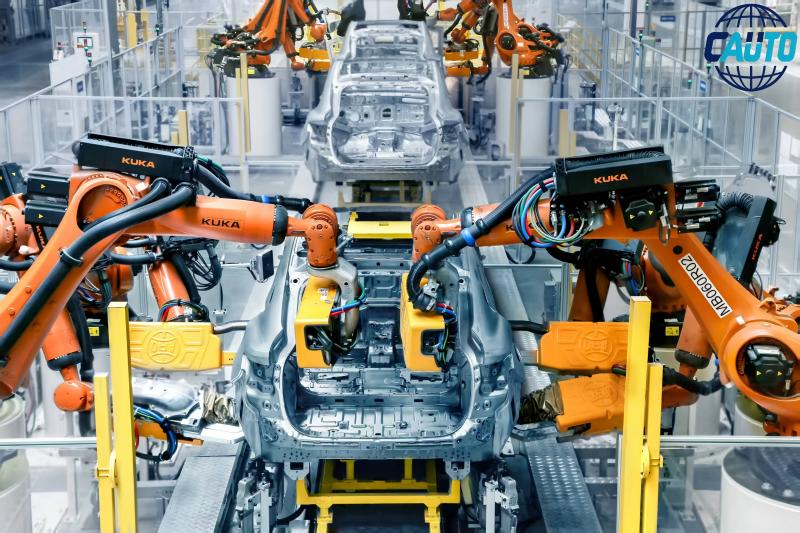
- Key Equipment: Spot welding robots, MIG/MAG welding stations, fixture jigs, body framing systems
- Robot Brands: KUKA, ABB, FANUC (all available through Chinese system integrators)
- Capacity Range: 5 JPH (low-volume SKD) to 60 JPH (high-volume CKD)
- Application: Sedan, SUV, pickup truck, and commercial van body-in-white assembly
2. Painting Line
- Key Equipment: Pre-treatment tanks, electrophoretic deposition (ED) systems, spray booths, drying ovens
- Technology: Water-based paint systems, robotic spray applicators (Dürr-compatible configurations)
- Compliance: VOC emission control systems available to meet international environmental standards
- Application: Primer, base coat, clear coat application with full automation
3. Final Assembly Line
- Key Equipment: Slat conveyor systems, overhead conveyors, wheel alignment stations, fluid filling stations
- Configuration: Flexible line design accommodating multiple models on a single conveyor
- Capacity: Adjustable from 3,000 to 100,000 units per year depending on client requirements
4. End-of-Line Testing & Inspection
- Key Equipment: Roll testing stands, headlight alignment testers, brake test benches, emission analyzers
- Software: Integrated MES (Manufacturing Execution System) for production tracking and quality control
- Standard: Configurable for Iranian national standards or international export certification requirements
China vs. Europe: The Cost & Technology Advantage
| Factor | Chinese Production Lines | European Production Lines |
|---|---|---|
| Capital Investment | 40–60% lower | Premium pricing |
| Delivery Timeline | 4–6 months | 8–14 months |
| Customization | High flexibility for CKD/SKD | Standardized configurations |
| Technical Training | Included; on-site Iranian engineer training | Additional cost |
| Spare Parts Availability | 48-hour dispatch from China | Extended lead times |
| After-Sales Support | Dedicated Chinese technicians; remote diagnostics | Limited regional presence |
Chinese automotive equipment has matured significantly over the past decade. Major Chinese production line builders now supply Tier-1 OEMs domestically and export to Russia, Southeast Asia, Africa, and Latin America — with quality certifications including ISO 9001, CE marking, and IRIS compliance.
How to Import Automotive Production Lines to Iran: Step-by-Step
Step 1: Define Your Production Model
Determine whether your project requires:
- CKD (Completely Knocked Down): Full production lines for body welding, painting, and assembly from imported kits
- SKD (Semi-Knocked Down): Simplified assembly lines for partial knock-down kits with higher local content
- Component Manufacturing: Specific lines for engines, transmissions, or stamped body panels
Step 2: Technical Specification & Factory Design
Work with a production line integrator to develop:
- Factory layout drawings (2D/3D CAD)
- Production capacity calculations (JPH / annual volume)
- Equipment specifications and robot configurations
- Utility requirements (power, compressed air, water treatment)
CAUTO Global coordinates directly with Chinese production line engineers to customize specifications for Iranian facility conditions, including voltage standards (230V/400V 50Hz), climate considerations, and available workshop dimensions.
Step 3: Contracting & Procurement
Key contract elements:
- FOB / CIF Bandar Abbas shipping terms
- Payment structure: Typically 30% advance, 70% against shipping documents (via trusted trade finance mechanisms)
- Warranty terms: 12–24 months equipment warranty with spare parts packages
- Training scope: On-site installation supervision and operator training in Iran
Step 4: Shipping & Customs Clearance
Automotive production lines are shipped as heavy machinery via container or break-bulk cargo:
- Containerized: Disassembled robots, conveyors, and control cabinets in 40HQ containers
- Break-Bulk: Large curing ovens, paint booths, and stamping presses shipped as individual cargo units
CAUTO Global manages export customs clearance in China, ocean freight booking, and provides full packing lists, commercial invoices, and certificates of origin required for Iranian customs.
Step 5: Installation & Commissioning
Upon arrival at your Iranian facility:
- Chinese installation engineers supervise reassembly and calibration
- Local Iranian technicians receive hands-on training
- Trial production runs validate line speed and quality targets
- Final acceptance testing confirms contractual performance guarantees
CKD vs. SKD vs. Complete Production Line: Which Fits Iran?
| Model | Investment Level | Local Content | Best For |
|---|---|---|---|
| SKD Assembly | $2–5 million | 15–25% | Entry-level market testing; low volume |
| CKD Full Line | $8–25 million | 40–60% | Established brands; medium-high volume |
| Complete Manufacturing | $30–80 million | 60–80% | Long-term industrial strategy; government-backed |
For most Iranian private investors and emerging automotive groups, CKD production lines offer the optimal balance of technology transfer, local value creation, and manageable capital outlay. CAUTO Global can structure phased investments where SKD lines are installed first, with CKD capability added as market volume grows.
Frequently Asked Questions (FAQ)
What is the typical investment for a complete CKD automotive production line in Iran?
A standard passenger car CKD line (welding + painting + assembly + testing) with annual capacity of 30,000–50,000 units typically requires $12–20 million USD, including equipment, shipping, installation, and initial training. SKD lines for 10,000–15,000 units can be established for $3–6 million USD.
How long does it take from order to operational production?
Total project timeline is typically 8–14 months: 3–4 months for design and manufacturing in China, 1–2 months for shipping to Bandar Abbas, and 3–4 months for installation, commissioning, and trial production in Iran.
Are Chinese production lines compatible with Iranian industrial standards?
Yes. Chinese equipment is built to international standards (ISO, CE) and can be configured for Iranian electrical specifications, safety codes, and environmental regulations. Control systems support English, Persian, and Chinese interfaces.
What about spare parts and long-term maintenance?
We recommend a 2-year initial spare parts package included in the contract. CAUTO Global maintains spare parts inventory and can dispatch critical components within 48–72 hours. Many Iranian clients also establish local spare parts warehouses for high-consumption items.
Can the production line be adapted for electric vehicle (EV) manufacturing?
Yes. Modern Chinese production lines are designed with EV-ready flexibility. Welding and painting processes remain largely identical, while assembly lines can be configured to accommodate battery pack installation, electric motor mounting, and high-voltage system testing — future-proofing your investment.
How are payments and currency handled given banking restrictions?
Most transactions are structured through third-country trade finance channels, cryptocurrency settlements, or barter arrangements. CAUTO Global has experience navigating these mechanisms and can recommend secure payment structures tailored to Iranian banking realities.
About CAUTO Global
CAUTO Global (China Automotive Global Supply Chain Co., Limited) is a specialized export company bridging China’s advanced automotive industry with growing markets worldwide. Our dual business model serves both vehicle importers and industrial investors seeking to establish local manufacturing capability.
Vehicle Export Division
We export new energy vehicles, PHEV pickup trucks, SUVs, sedans, and commercial vehicles from China’s leading OEMs to distributors and fleet operators across Africa, the Middle East, South America, and Central Asia.
Production Line Export Division
We design, source, and deliver complete automotive manufacturing solutions:
- Body Welding Lines: Robot-integrated spot welding, arc welding, and laser welding systems
- Painting Lines: Pre-treatment, ED coating, robotic spray application, and curing ovens
- Final Assembly Lines: Conveyor systems, wheel alignment, fluid filling, and interior trim installation
- Testing & Inspection: End-of-line validation equipment with integrated quality management software
Our Value Proposition for Iranian Clients
- Turn-Key Solutions: From factory design to commissioning, we manage the complete project
- Competitive Pricing: 40–60% cost advantage over European equipment suppliers
- Proven Technology: Equipment already operational in Russia, Southeast Asia, Africa, and Latin America
- Iran-Specific Experience: Understanding of local standards, logistics constraints, and business practices
- Long-Term Partnership: Spare parts supply, technical upgrades, and capacity expansion support
Planning to establish an automotive assembly plant in Iran?
Contact CAUTO Global today for a free project feasibility assessment, equipment quotation, and factory layout consultation tailored to your production targets.
© 2026 CAUTO Global — China Automotive Global Supply Chain Co., Limited. All technical specifications and market information are provided for reference. Final project configurations are subject to technical survey and contractual agreement.