
What is a CKD Assembly Line?
A CKD (Completely Knocked Down) Assembly Line is a complete manufacturing system that transforms imported disassembled vehicle components into fully homologated, road-ready finished products. Unlike SKD (Semi-Knocked Down) operations that perform only final assembly, CKD plants execute the full manufacturing value chain: Body-in-White (BIW) welding, surface treatment and painting, powertrain marriage, final assembly, and end-of-line testing.
For emerging market governments implementing local manufacturing mandates and import substitution policies, establishing a CKD assembly plant is the strategic pathway to:
- Qualify for government industrial incentives and tax exemptions
- Create high-skill local employment (150–800+ jobs per plant)
- Reduce foreign exchange outflow through progressive component localization
- Build domestic automotive supply chain ecosystems
CKD vs SKD Decision Framework:
| Factor | CKD Assembly Line | SKD Assembly Line |
|---|---|---|
| Local Value Added | 40–60% | 20–35% |
| Required Infrastructure | Welding + Painting + Assembly + Testing | Final Assembly + Testing Only |
| Investment Level | $8M–$25M | $3M–$8M |
| Workforce Size | 200–800 | 80–200 |
| Government Incentive Eligibility | Full | Partial |
| Technology Transfer Depth | Complete | Limited |
| Best For | Long-term industrial base, high-volume mandates | Fast market entry, budget constraints |
EV Car CKD Assembly Line | Our Flagship Solution
Overview
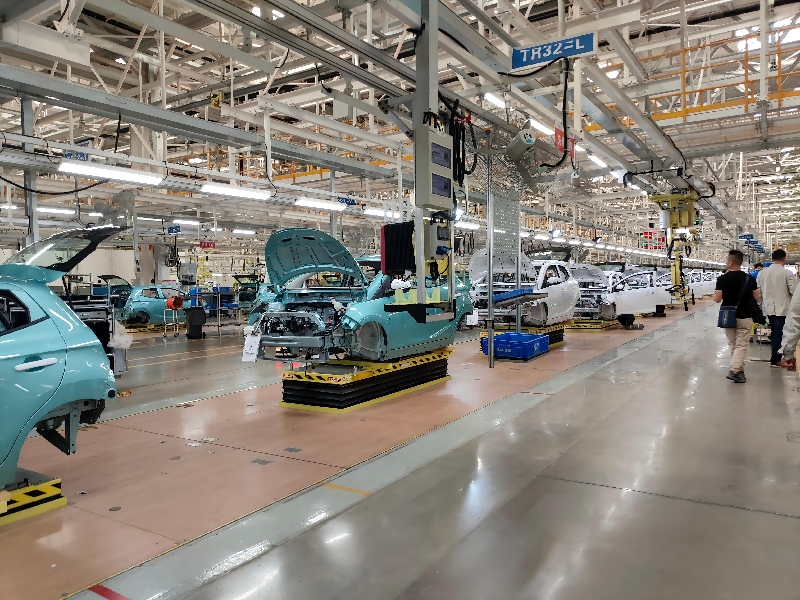
The EV Car CKD Assembly Line is our most advanced and in-demand solution, engineered for the global electric vehicle manufacturing transition. Designed for passenger electric vehicles—including sedans, hatchbacks, crossovers, and compact SUVs—this line integrates battery system marriage, high-voltage safety protocols, and thermal management assembly that ICE vehicle lines cannot accommodate.
Technical Specifications
| Specification | Standard Configuration | Premium Configuration |
|---|---|---|
| JPH (Jobs Per Hour) | 15–30 | 30–60 |
| Annual Capacity | 20,000–80,000 units | 80,000–200,000 units |
| Vehicle Platform | Compact sedan/hatchback/Crossover | Mid-size sedan/SUV/Crossover multi-platform |
| Automation Level | Semi-automatic (40% robot, 60% manual assist) | Fully automatic (75% robot, 25% manual) |
| Floor Space | 25,000–40,000 m² | 45,000–80,000 m² |
| Power Requirement | 3,500–6,000 kW | 8,000–15,000 kW |
| Welding Robots | KUKA KR QUANTEC nano Series (6-axis, 90 kg payload) × 45 units | KUKA KR QUANTEC pro Series (6-axis, 150 kg payload) × 85 units |
| Spot Welding Guns | Bosch Rexroth servo guns with adaptive control | Bosch Rexroth medium-frequency DC guns |
| Painting System | Dürr EcoDryScrubber dry separation + EcoBell3 atomizer | Dürr EcoDryX + EcoRP E043 robotic atomizer + PVC underbody |
| ED Coating | Dühr E-Coat full immersion system | Dürr RoDip M rotation dip system |
| Conveyor System | Dürr skid conveyor (friction-driven) | Dürr Power&Free overhead + floor skid hybrid |
| Battery Marriage Station | Semi-auto AGV-guided with torque monitoring | Fully automatic robotic battery pack installation |
| HV Safety Testing | Insulation resistance + HV interlock + leakage current | Full Hi-Pot test + BMS communication validation |
| Thermal Management | Manual coolant circuit filling + vacuum | Automated refrigerant charge + leak detection |
| End-of-Line Testing | Chassis dynamometer + brake test + headlight align | 4-post dynamometer + NVH test + ADAS calibration |
| MES Integration | SCADA-based production tracking | Siemens Opcenter / Dürr DXQ full MES suite |
| Quality Standard | ISO 9001, Class A paint surface | ISO 9001 + IATF 16949, Class A+ paint |
Process Flow: 4-Shop Integrated System
Shop 1: Body-in-White (BIW) Welding
Equipment Configuration:
- KUKA KR QUANTEC nano F robots (45–85 units depending on JPH)
- Reach: 2,033–2,901 mm
- Repeatability: ±0.06 mm
- Controller: KR C5 micro with KUKA.SystemSoftware 8.7
- Welding software: KUKA.ArcTech, KUKA.ServoGun
- Bosch Rexroth servo welding guns
- Force range: 200–600 daN
- Adaptive welding control with real-time quality monitoring
- Fixtures: Quick-change modular tooling systems (Schunk modulra)
- Changeover time: <15 minutes per model variant
- Multi-platform capability: Sedan + hatchback + crossover on shared line
- Quality Gate: Online laser measurement station (Perceptron ScanR)
- Body dimensional accuracy: ±0.5 mm critical points
Process Stations:
- Underbody sub-assembly (front floor, rear floor, center tunnel)
- Side frame assembly (left/right inner/outer panels)
- Main body marriage (underbody + side frames + roof)
- Closure assembly (doors, hood, trunk lid — pre-hung offline)
- Laser measurement + manual audit
EV-Specific Adaptation: Reinforced floor pan welding for battery pack mounting points; additional structural adhesive application stations for torsional rigidity enhancement.
Shop 2: Painting & Surface Treatment
Equipment Configuration:
- Dürr EcoDryScrubber dry overspray separation system
- Eliminates water usage in paint booth recirculation
- VOC reduction: 30% vs conventional wet scrubber
- Dürr EcoBell3 high-speed rotary atomizer
- Transfer efficiency: 85%+ (vs 60% conventional)
- Paint savings: 15–20% annually
- Dürr RoDip M rotation dip system for E-Coat
- Complete immersion coverage including cavity sealing
- Film thickness uniformity: ±2 μm
- Curing Ovens: Gas-fired convection (standard) or electric infrared (premium)
- Temperature profile: 180°C × 20 min (ED) / 140°C × 25 min (topcoat)
- Paint Supply: Dürr EcoSupply P paint circulation system
- Color change time: <12 seconds
- Supports 8–12 exterior colors + 4 interior trim colors
Process Stations:
- Pretreatment (degrease → phosphate → passivation)
- E-Coat immersion (cathodic epoxy, 18–22 μm thickness)
- PVC underbody sealing + seam sealing (robot-applied)
- Primer surfacer spray (2K polyurethane)
- Basecoat spray (waterborne, 2–3 coats)
- Clearcoat spray (2K acrylic, 2 coats)
- Curing and cooling
- Paint quality audit (gloss, orange peel, color match)
EV-Specific Adaptation: Enhanced cavity wax injection for battery compartment corrosion protection; aluminum body panel compatible pretreatment chemistry.
Shop 3: Final Assembly & Battery Marriage
Equipment Configuration:
- Dürr skid conveyor system (friction-driven or Power&Free)
- Carrier capacity: 2,500 kg (standard EV sedan)
- Variable speed: 0.5–4 m/min
- Battery Marriage Station:
- AGV-guided battery pack positioning (KUKA KMP 1500 or equivalent)
- Torque-controlled bolting: 12-point fastening, 180 Nm ±5%
- HV connector mating with position verification
- Thermal Management Station:
- Coolant vacuum fill + pressure test (Grundfos pump system)
- Refrigerant charge (R1234yf or R134a, 350–750g capacity)
- Leak detection: Helium mass spectrometer (sensitivity 1×10⁻⁹ mbar·L/s)
- Electrical Assembly:
- Wire harness routing with guided assembly displays
- High-voltage cable installation with safety interlock verification
- 12V auxiliary battery installation
Process Stations:
- Interior trim marriage (dashboard, carpet, headliner, seats)
- Door assembly (window regulator, trim panel, seal)
- Battery pack marriage (AGV positioning → robotic bolting → HV connection)
- Motor + reducer + suspension marriage (front/rear axle sub-assembly)
- Wheel assembly (tire + rim marriage → automatic wheel mounting)
- Brake fluid fill + bleed (vacuum pressure method)
- Coolant fill + thermal system validation
- Refrigerant charge + A/C performance test
- Exterior trim + badge + glass installation
- Charging port installation + functionality test
EV-Specific Critical Controls:
- Battery pack barcode traceability (cell-level → module-level → pack-level)
- HV interlock continuity verification at 5 assembly gates
- Insulation resistance test: ≥500 MΩ @ 500V DC
- BMS (Battery Management System) communication handshake validation
Shop 4: End-of-Line Testing & Quality Validation
Equipment Configuration:
- Chassis Dynamometer: 4-post or 2-post roller bed (Horiba or Maha)
- Speed range: 0–200 km/h
- Power measurement: ±0.5% accuracy
- Brake Tester: Roller brake tester with ABS function test
- Force measurement: ±3% accuracy per wheel
- Headlight Aligner: Hella or Bosch beam setter
- Horizontal/vertical adjustment with automated feedback
- Wheel Aligner: 3D camera-based (Hunter or Corghi)
- Toe, camber, caster, thrust angle measurement
- Water Leak Test: Rain simulation chamber (150–200 mm/hr intensity)
- ADAS Calibration: Static and dynamic calibration rigs (if equipped)
- Camera, radar, ultrasonic sensor alignment
Test Protocol:
- Pre-test electrical system scan (OBD-II + manufacturer-specific protocols)
- Static electrical test (all lighting, signals, infotainment, HVAC)
- Brake performance test (deceleration rate, ABS cycling)
- Dynamometer run (power verification, regenerative braking function)
- Wheel alignment verification
- Headlight beam pattern validation
- Water leak test (15-minute spray cycle)
- Charging functionality test (AC Level 2 + DC fast charge port verification)
- Road test (3–5 km track, NVH assessment, handling validation)
- Final quality audit + documentation
EV Car Line Customization Options
| Upgrade Module | Description | Investment Impact |
|---|---|---|
| Multi-Platform Flexibility | Switch between 2–3 EV platforms (compact/mid-size/SUV) with <20 min changeover | +15–25% |
| Solid-State Battery Ready | Structural reinforcement + thermal runaway containment for next-gen battery chemistry | +8–12% |
| 800V Architecture Support | Upgraded HV testing equipment, specialized connector handling | +5–8% |
| Autonomous Driving Prep | ADAS sensor calibration + OTA validation station | +10–15% |
| Solar Panel Integration | Roof-integrated PV module assembly station (for solar EV variants) | +3–5% |
| Right-Hand Drive Conversion | Mirror-image assembly stations for RHD markets | +8–10% |
Passenger SUV CKD Assembly Line | Compact to Full-Size
JPH: 12–45 | Capacity: 8,000–150,000 units/year | Floor Space: 22,000–65,000 m²
Key Differentiators:
- Body Structure: Unibody welding fixtures with reinforced roof rails and A-pillars for rollover protection; optional body-on-frame capability for ladder-frame SUVs
- Powertrain Marriage: All-wheel-drive (AWD) transfer case installation station; higher-torque fastening requirements (up to 350 Nm)
- Ground Clearance Ergonomics: Elevated assembly platforms (vs. sedan lines) for underbody component access
- Interior Volume: Larger cabin space requires extended dashboard marriage tooling and third-row seat installation stations (7-seat variants)
Equipment Snapshot:
- Welding: KUKA KR QUANTEC pro (120 kg payload) × 35–70 units
- Painting: Dürr EcoDryScrubber + EcoBell3 (same EV line core, adjusted booth dimensions)
- Testing: Enhanced brake system for heavier vehicle mass; hill-hold function validation
Process Note: SUV lines share 70% equipment DNA with EV car lines, enabling cost-efficient multi-vehicle facility design when SUV and sedan platforms share wheelbase architectures.
Commercial Truck CKD Assembly Line | Light to Heavy Duty
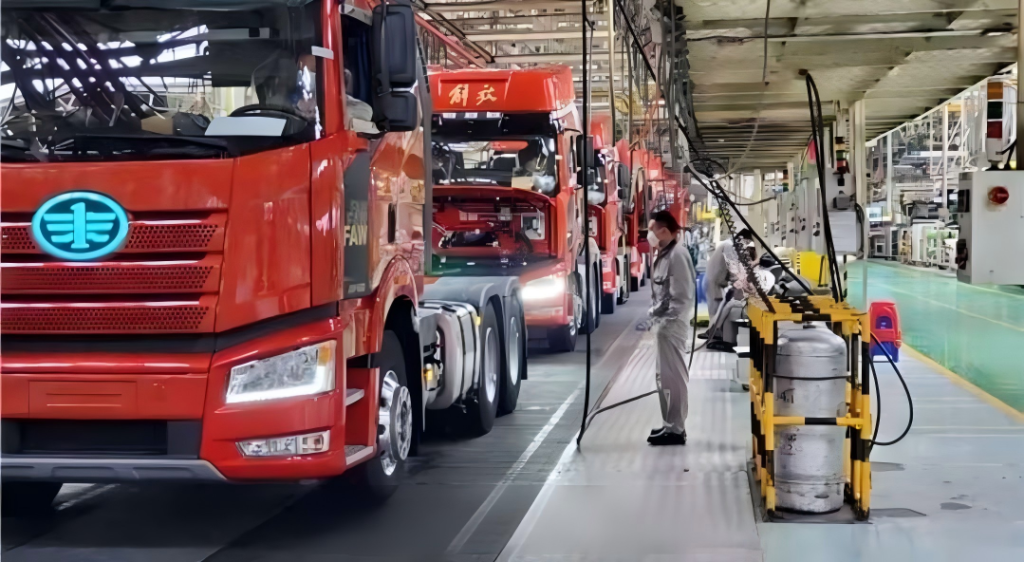
JPH: 3–15 | Capacity: 2,000–50,000 units/year | Floor Space: 18,000–45,000 m²
Key Differentiators:
- Chassis Marriage: Heavy-duty frame assembly with riveted/bolted crossmembers (up to 40-ton GVW capacity); manual-assisted lifting for heavy axles and suspension
- Cab Production: Separate cab welding/painting line (smaller booth, dedicated fixtures) then marriage to chassis
- Power Take-Off (PTO): Optional PTO installation station for vocational trucks (dump, mixer, cargo)
- Body Variants: Flatbed, van, refrigerated box, tanker — quick-change body mounting fixtures
Equipment Snapshot:
- Welding: KUKA KR QUANTEC ultra (240 kg payload) for heavy frame welding; manual MIG for complex joints
- Painting: Dürr cab painting line (smaller scale); chassis shot blasting + powder coating option
- Conveyor: Heavy-duty chain conveyor (5,000–12,000 kg carrier capacity)
City Bus & Coach CKD Assembly Line | Urban to Intercity
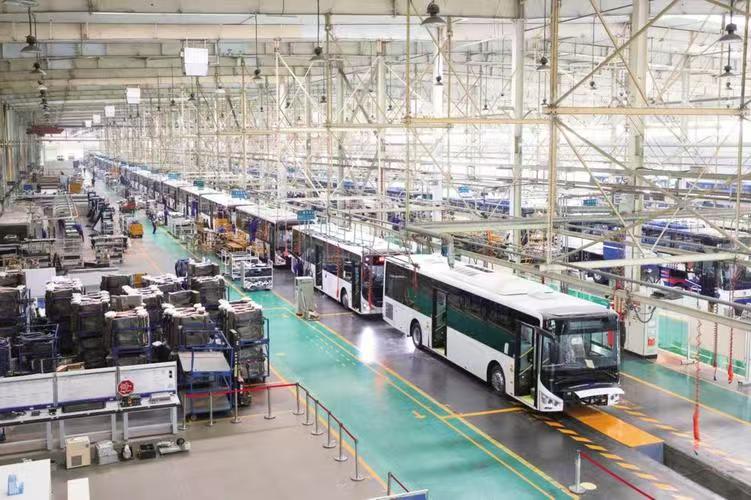
JPH: 2–8 | Capacity: 1,000–20,000 units/year | Floor Space: 15,000–35,000 m²
Key Differentiators:
- Monocoque vs Frame Construction: Adaptable fixtures for both integral body buses and separate chassis + body designs
- Door Configuration: 1-door (mini-bus), 2-door (city bus), 3-door (articulated) — pneumatic door installation and testing stations
- Accessibility: Wheelchair lift/ramp integration station with load test (350 kg capacity)
- Low-Floor Platform: Sub-floor battery/cng tank mounting (for electric/CNG buses)
Equipment Snapshot:
- Welding: KUKA large-reach robots (3,400 mm reach) for side wall panel welding; significant manual welding for complex curvature sections
- Painting: Dürr large-component spray booth (15m × 5m × 4m dimensions); brush-applied topcoat touch-up stations
- Assembly: Floor-mounted jigs for body alignment; pneumatic tool stations for high-torque bus-specific fasteners
Motorcycle CKD Assembly Line | Scooter to Heavy Cruiser
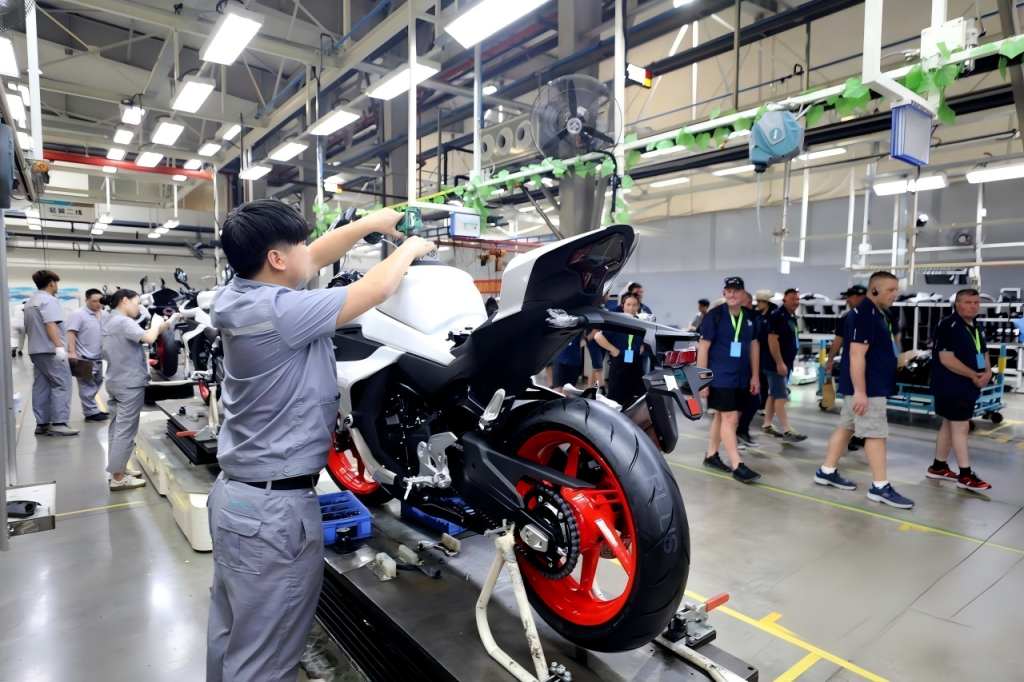
JPH: 20–80 | Capacity: 15,000–300,000 units/year | Floor Space: 6,000–18,000 m²
Key Differentiators:
- Compact Footprint: 50–70% smaller than car lines; modular cell-based layout vs. linear conveyor
- Engine Marriage Precision: Smaller tolerances (±0.2 mm) for engine-to-frame mounting; critical for vibration and longevity
- Multi-Variant Quick-Change: Scooter (50–150cc), sport (250–600cc), cruiser (750–1000cc) — fixture changeover <10 minutes
- Surface Treatment: Cathodic electrodeposition (CED) for frame corrosion protection; powder coating for body panels
Equipment Snapshot:
- Welding: KUKA KR AGILUS series (small payload, high precision) for frame welding; manual TIG for exhaust and specialty joints
- Painting: Compact Dürr spray booth (6m × 3m × 3m); dip tank for frame CED
- Assembly: Pallet-based conveyor (250 kg capacity); manual assembly with guided torque tools (Atlas Copco nutrunners)
- Testing: Chassis dynamometer (2-wheel roller); brake test (hydraulic pressure validation); headlight alignment; noise emission test
Multi-Vehicle Technical Specifications Matrix
| Parameter | EV Car | SUV | Truck | Bus | Motorcycle |
|---|---|---|---|---|---|
| JPH Range | 15–60 | 12–45 | 3–15 | 2–8 | 20–80 |
| Annual Capacity | 20K–200K | 8K–150K | 2K–50K | 1K–20K | 15K–300K |
| Welding Robots | KUKA KR QUANTEC nano/pro (45–85) | KUKA KR QUANTEC pro (35–70) | KUKA KR QUANTEC ultra + manual (20–40) | KUKA large-reach + manual (15–30) | KUKA KR AGILUS + manual (10–25) |
| Spot Welding | Bosch Rexroth servo | Bosch Rexroth servo | Manual MIG/TIG hybrid | Manual MIG dominant | Manual TIG dominant |
| Painting System | Dürr EcoDryScrubber + EcoBell3 + RoDip M | Dürr EcoDryScrubber + EcoBell3 | Dürr cab line + chassis powder coat | Dürr large booth + brush touch-up | Dürr compact booth + CED dip |
| Conveyor Type | Dürr skid (friction/P&F) | Dürr skid (friction/P&F) | Heavy chain (5–12t) | Floor jigs + chain | Pallet conveyor (250kg) |
| Battery/Powertrain | Battery marriage + HV test | ICE/EV powertrain marriage | Diesel/CNG/EV chassis marriage | Electric/CNG/diesel | Engine-frame marriage |
| Assembly Stations | 18–28 | 16–24 | 12–18 | 10–16 | 8–14 |
| Testing Protocols | Dyno + brake + align + HV + ADAS | Dyno + brake + align + 4WD test | Brake + road + PTO + load | Brake + door + ramp + road | Dyno + brake + align + noise |
| Floor Space (m²) | 25K–80K | 22K–65K | 18K–45K | 15K–35K | 6K–18K |
| Power (kW) | 3,500–15,000 | 3,000–12,000 | 2,500–8,000 | 2,000–6,000 | 800–2,500 |
| Automation Level | 40–75% | 35–70% | 20–45% | 15–35% | 15–30% |
| Workforce | 200–800 | 180–650 | 150–400 | 120–300 | 80–200 |
| Project Timeline | 10–14 months | 10–13 months | 9–12 months | 9–12 months | 8–11 months |
The 7-Step CKD Implementation Process
| Phase | Duration | Key Activities | Deliverables |
|---|---|---|---|
| 1. Technical Consultation | 2–4 weeks | Vehicle platform analysis, capacity planning, facility audit, utility assessment | Process design proposal, preliminary layout, BOM estimate |
| 2. Engineering Design | 4–6 weeks | 3D factory modeling, digital twin simulation, utility integration planning, environmental compliance roadmap | Approved GA drawings, utility load calculations, HSE plan |
| 3. Equipment Manufacturing | 16–24 weeks | Robot programming, fixture fabrication, painting system build, conveyor assembly, FAT at supplier factory | Factory Acceptance Test report, shipping documentation |
| 4. Shipping & Logistics | 4–6 weeks | FCL/break-bulk coordination, customs documentation (HS codes, certificates of origin), insurance | Delivered to port, customs cleared |
| 5. Installation | 8–12 weeks | Mechanical erection, utility connection, robot positioning, conveyor alignment, electrical termination | Mechanical completion certificate |
| 6. Commissioning | 4–6 weeks | Cold run, hot run, robot calibration, painting recipe development, trial production, quality validation | Commissioning report, first article approval |
| 7. Training & Handover | 2–4 weeks | Operator training (theory + practical), maintenance training, documentation handover, spare parts inventory, 3-day stable production run | Handover certificate, 12-month warranty activation |
Total Project Cycle: 8–14 months from contract signature to stable production.
Why Choose CAUTO Turnkey CKD Solutions?
China Automotive Global Supply Chain Co., Limited (CAUTO) delivers integrated automotive production line solutions engineered for emerging market success.
6 Competitive Differentiators
1. Integrated 4-Shop Single-Contract Capability Unlike suppliers offering partial solutions (welding-only or painting-only), CAUTO delivers complete Welding + Painting + Assembly + Testing lines under one project management structure—eliminating interface risks and accountability gaps.
2. Multi-Vehicle Platform Expertise Proven delivery across EV cars, SUVs, trucks, buses, and motorcycles. Shared engineering DNA between platforms reduces your facility’s future expansion costs by 30–40% when adding vehicle categories.
3. Emerging Market Specialization Climate-hardened equipment (tropical-rated robot controllers, humidity-resistant painting systems), local workforce training programs in French/Arabic/Spanish/English, and regional spare parts depot strategies.
4. Scalable Modularity Start with SKD assembly, upgrade to full CKD, expand JPH capacity—all without replacing core line infrastructure. Modular conveyor sections and robot cells enable phased investment aligned with market demand growth.
5. Compliance Navigation Support ISO 9001:2015 and CE-marked equipment as standard. Local homologation documentation packages (FMVSS, ECE, GSO, SASO adaptations) prepared in local languages to accelerate your regulatory approval process.
6. Lifecycle Partnership 2-year critical spare parts package included. Remote diagnostic capability via secure VPN. Annual technical audit and upgrade consultation to maintain your competitive production efficiency.
Compliance & Certification Standards
| Standard | Application | Certification Body |
|---|---|---|
| ISO 9001:2015 | Quality management system | TÜV SÜD / SGS |
| ISO 14001:2015 | Environmental management | TÜV SÜD |
| CE Marking | Machinery safety directive (EU) | Notified Body |
| ISO 15614 | Welding procedure qualification | TWI / CSWIP |
| Class A Paint Surface | Automotive exterior finish quality | Internal + customer audit |
| VOC Emission Compliance | Painting environmental control | Local EPA equivalent |
| ECE Regulations | Vehicle homologation support (UN) | Technical documentation |
| GSO/SASO | GCC/Saudi market compliance | Local certification support |
Global Reference Projects
| Region | Vehicle Type | JPH | Capacity | Key Scope |
|---|---|---|---|---|
| Middle East | Passenger Car (ICE + EV) | 30 | 50,000/year | Full 4-shop, Dürr painting, KUKA robots, 18-month ROI |
| North Africa | Compact SUV | 15 | 25,000/year | Welding + painting + assembly, progressive localization 20%→55% |
| Southeast Asia | Light Commercial Truck | 8 | 12,000/year | CKD line with PTO vocational options, local steel sourcing integration |
| CIS Region | Motorcycle (multiple cc) | 40 | 100,000/year | Compact line, 6-model flexibility, 8-month project delivery |
| Latin America | City Bus (Electric + CNG) | 4 | 6,000/year | Low-floor platform, 2/3-door variants, wheelchair accessibility |
Optional Upgrade Modules
| Module | Description | Typical Investment |
|---|---|---|
| SKD-to-CKD Upgrade Path | Retrofit welding and painting capability to existing SKD facility | $2M–$6M |
| MES/SCADA Integration | Siemens Opcenter or Dürr DXQ manufacturing execution system with real-time OEE tracking | $300K–$800K |
| Local Component Integration Stations | Progressive localization modules: stamping press, injection molding, wire harness | $1M–$5M per station |
| Environmental Compliance Package | VOC thermal oxidizer, wastewater treatment, noise attenuation | $500K–$1.5M |
| Solar Power Integration | Rooftop PV system to offset 30–50% facility energy consumption | $200K–$600K |
| Second Shift Preparation | Duplicated tooling sets, expanded utility capacity, additional training | $1M–$3M |
Frequently Asked Questions
What is the minimum project scope for a CKD line?
CKD lines are fully customized turnkey projects rather than catalog products. Minimum viable scope is a complete welding + assembly + testing configuration for a single vehicle platform, typically targeting 10,000+ units/year annual capacity. SKD assembly lines offer lower entry points (3,000+ units/year) with upgrade paths to full CKD.
Can one production line handle multiple vehicle types?
Yes, with modular fixture systems and programmable robot paths. Our EV car and SUV lines share 70% equipment DNA when platforms share wheelbase architectures. Truck/bus/motorcycle require dedicated lines due to fundamentally different component scales. Multi-model flexibility adds 15–25% to initial investment but reduces long-term expansion costs.
How long does installation and commissioning take?
8–12 weeks for installation (mechanical + electrical + utility connection) + 4–6 weeks for commissioning (calibration, recipe development, trial production). Total on-site implementation: 3–4 months. Chinese installation engineers remain on-site until 3 consecutive days of stable target-JPH production are achieved.
What training is provided for local operators and engineers?
Three-phase program: (1) 2–3 weeks pre-commissioning classroom training in China for your lead engineers (travel costs borne by buyer); (2) 4–6 weeks on-the-job training during your local installation; (3) ongoing remote support via secure diagnostic access. All manuals provided in English/French/Arabic/Spanish as required. Operator certification programs included.
What spare parts and warranty coverage is included?
2-year critical spare parts package included in base contract (robot servo motors, welding gun components, conveyor wear parts, paint spray nozzles, pneumatic valves). Core equipment warranty: 12 months post-handover. Extended warranty and annual maintenance contracts available. Regional spare parts depot establishment support for rapid replenishment.
Do you offer financing or phased payment options?
Standard terms: 30% advance, 30% pre-shipment after Factory Acceptance Test, 30% post-installation acceptance, 10% retention after 12-month stable operation. For qualified government-backed projects, Chinese export credit (Sinosure) and structured buyer financing may be available. Project-specific financing proposals developed during technical consultation phase.
Request Your Custom CKD Line Proposal
China Automotive Global Supply Chain Co., Limited (CAUTO) is ready to engineer your automotive manufacturing future.
Whether you are launching an EV car assembly plant in the Middle East, expanding truck production in Africa, or building motorcycle capacity in Latin America, our turnkey CKD solutions deliver proven technology, regulatory compliance, and sustainable local employment.
Next Step: Complete the form below to request a technical consultation. Our engineering team will analyze your vehicle platform, target capacity, and facility parameters to deliver a customized process design and investment framework within 5 business days.
[Form Fields]
- Full Name
- Company/Organization
- Email Address
- Phone/WhatsApp
- Target Market / Country
- Vehicle Type (select): EV Car / Passenger SUV / Commercial Truck / City Bus / Motorcycle / Multiple
- Target Annual Capacity (units/year)
- Facility Status: Greenfield (new construction) / Brownfield (existing building)
- Project Timeline: Immediate / 6–12 months / 12–24 months / Exploratory
- Additional Requirements (message box)