
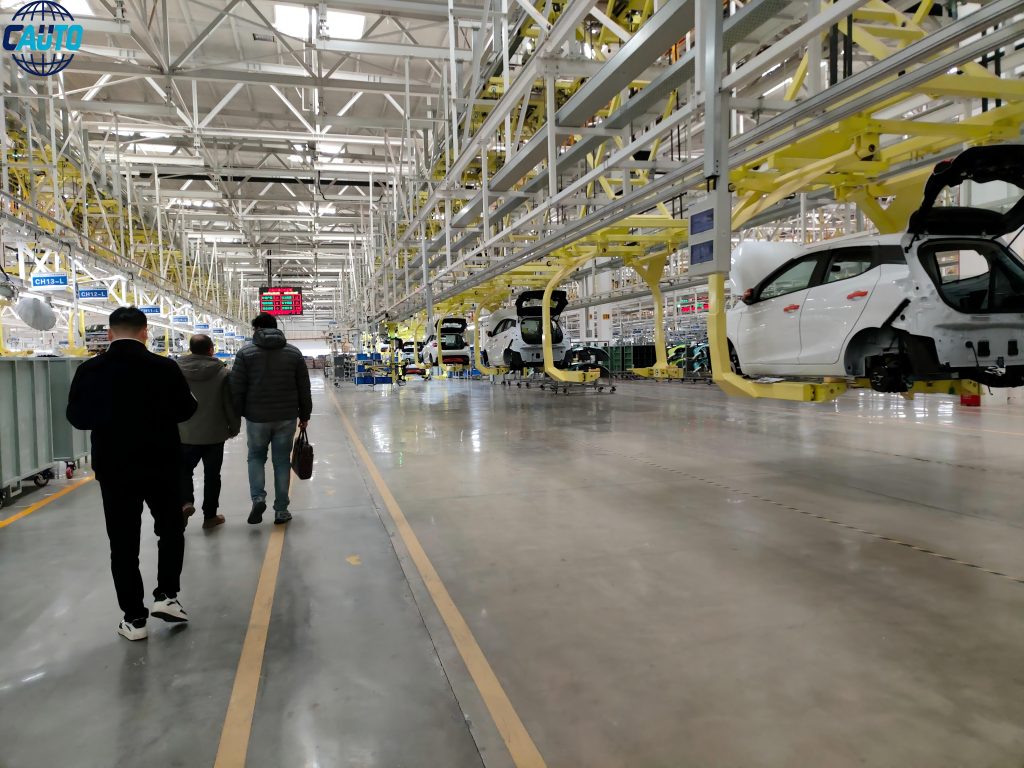
EV Car SKD/CKD Assembly Line | Flagship Solution From China
Contact Us for Pricing
Interested in this product? Contact us now for detailed pricing and product information.
Product Details
Overview
The EV Car SKD/CKD Assembly Line is our most advanced and in-demand solution, engineered for the global electric vehicle manufacturing transition. Designed for passenger electric vehicles—including sedans, hatchbacks, crossovers, and compact SUVs—this line integrates battery system marriage, high-voltage safety protocols, and thermal management assembly that ICE vehicle lines cannot accommodate.
Technical Specifications
| Specification | Standard Configuration | Premium Configuration |
|---|---|---|
| JPH (Jobs Per Hour) | 15–30 | 30–60 |
| Annual Capacity | 20,000–80,000 units | 80,000–200,000 units |
| Vehicle Platform | Compact sedan/hatchback/Crossover | Mid-size sedan/SUV/Crossover multi-platform |
| Automation Level | Semi-automatic (40% robot, 60% manual assist) | Fully automatic (75% robot, 25% manual) |
| Floor Space | 25,000–40,000 m² | 45,000–80,000 m² |
| Power Requirement | 3,500–6,000 kW | 8,000–15,000 kW |
| Welding Robots | KUKA KR QUANTEC nano Series (6-axis, 90 kg payload) × 45 units | KUKA KR QUANTEC pro Series (6-axis, 150 kg payload) × 85 units |
| Spot Welding Guns | Bosch Rexroth servo guns with adaptive control | Bosch Rexroth medium-frequency DC guns |
| Painting System | Dürr EcoDryScrubber dry separation + EcoBell3 atomizer | Dürr EcoDryX + EcoRP E043 robotic atomizer + PVC underbody |
| ED Coating | Dühr E-Coat full immersion system | Dürr RoDip M rotation dip system |
| Conveyor System | Dürr skid conveyor (friction-driven) | Dürr Power&Free overhead + floor skid hybrid |
| Battery Marriage Station | Semi-auto AGV-guided with torque monitoring | Fully automatic robotic battery pack installation |
| HV Safety Testing | Insulation resistance + HV interlock + leakage current | Full Hi-Pot test + BMS communication validation |
| Thermal Management | Manual coolant circuit filling + vacuum | Automated refrigerant charge + leak detection |
| End-of-Line Testing | Chassis dynamometer + brake test + headlight align | 4-post dynamometer + NVH test + ADAS calibration |
| MES Integration | SCADA-based production tracking | Siemens Opcenter / Dürr DXQ full MES suite |
| Quality Standard | ISO 9001, Class A paint surface | ISO 9001 + IATF 16949, Class A+ paint |
Process Flow: 4-Shop Integrated System
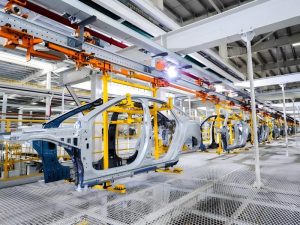
Shop 1: Body-in-White (BIW) Welding
Equipment Configuration:
- KUKA KR QUANTEC nano F robots (45–85 units depending on JPH)
- Reach: 2,033–2,901 mm
- Repeatability: ±0.06 mm
- Controller: KR C5 micro with KUKA.SystemSoftware 8.7
- Welding software: KUKA.ArcTech, KUKA.ServoGun
- Bosch Rexroth servo welding guns
- Force range: 200–600 daN
- Adaptive welding control with real-time quality monitoring
- Fixtures: Quick-change modular tooling systems (Schunk modulra)
- Changeover time: <15 minutes per model variant
- Multi-platform capability: Sedan + hatchback + crossover on shared line
- Quality Gate: Online laser measurement station (Perceptron ScanR)
- Body dimensional accuracy: ±0.5 mm critical points
Process Stations:
- Underbody sub-assembly (front floor, rear floor, center tunnel)
- Side frame assembly (left/right inner/outer panels)
- Main body marriage (underbody + side frames + roof)
- Closure assembly (doors, hood, trunk lid — pre-hung offline)
- Laser measurement + manual audit
EV-Specific Adaptation: Reinforced floor pan welding for battery pack mounting points; additional structural adhesive application stations for torsional rigidity enhancement.
Shop 2: Painting & Surface Treatment
Equipment Configuration:
- Dürr EcoDryScrubber dry overspray separation system
- Eliminates water usage in paint booth recirculation
- VOC reduction: 30% vs conventional wet scrubber
- Dürr EcoBell3 high-speed rotary atomizer
- Transfer efficiency: 85%+ (vs 60% conventional)
- Paint savings: 15–20% annually
- Dürr RoDip M rotation dip system for E-Coat
- Complete immersion coverage including cavity sealing
- Film thickness uniformity: ±2 μm
- Curing Ovens: Gas-fired convection (standard) or electric infrared (premium)
- Temperature profile: 180°C × 20 min (ED) / 140°C × 25 min (topcoat)
- Paint Supply: Dürr EcoSupply P paint circulation system
- Color change time: <12 seconds
- Supports 8–12 exterior colors + 4 interior trim colors
Process Stations:
- Pretreatment (degrease → phosphate → passivation)
- E-Coat immersion (cathodic epoxy, 18–22 μm thickness)
- PVC underbody sealing + seam sealing (robot-applied)
- Primer surfacer spray (2K polyurethane)
- Basecoat spray (waterborne, 2–3 coats)
- Clearcoat spray (2K acrylic, 2 coats)
- Curing and cooling
- Paint quality audit (gloss, orange peel, color match)
EV-Specific Adaptation: Enhanced cavity wax injection for battery compartment corrosion protection; aluminum body panel compatible pretreatment chemistry.
Shop 3: Final Assembly & Battery Marriage
Equipment Configuration:
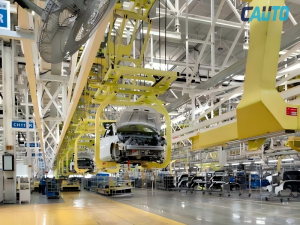
- Dürr skid conveyor system (friction-driven or Power&Free)
- Carrier capacity: 2,500 kg (standard EV sedan)
- Variable speed: 0.5–4 m/min
- Battery Marriage Station:
- AGV-guided battery pack positioning (KUKA KMP 1500 or equivalent)
- Torque-controlled bolting: 12-point fastening, 180 Nm ±5%
- HV connector mating with position verification
- Thermal Management Station:
- Coolant vacuum fill + pressure test (Grundfos pump system)
- Refrigerant charge (R1234yf or R134a, 350–750g capacity)
- Leak detection: Helium mass spectrometer (sensitivity 1×10⁻⁹ mbar·L/s)
- Electrical Assembly:
- Wire harness routing with guided assembly displays
- High-voltage cable installation with safety interlock verification
- 12V auxiliary battery installation
Process Stations:
- Interior trim marriage (dashboard, carpet, headliner, seats)
- Door assembly (window regulator, trim panel, seal)
- Battery pack marriage (AGV positioning → robotic bolting → HV connection)
- Motor + reducer + suspension marriage (front/rear axle sub-assembly)
- Wheel assembly (tire + rim marriage → automatic wheel mounting)
- Brake fluid fill + bleed (vacuum pressure method)
- Coolant fill + thermal system validation
- Refrigerant charge + A/C performance test
- Exterior trim + badge + glass installation
- Charging port installation + functionality test
EV-Specific Critical Controls:
- Battery pack barcode traceability (cell-level → module-level → pack-level)
- HV interlock continuity verification at 5 assembly gates
- Insulation resistance test: ≥500 MΩ @ 500V DC
- BMS (Battery Management System) communication handshake validation
Shop 4: End-of-Line Testing & Quality Validation
Equipment Configuration:
- Chassis Dynamometer: 4-post or 2-post roller bed (Horiba or Maha)
- Speed range: 0–200 km/h
- Power measurement: ±0.5% accuracy
- Brake Tester: Roller brake tester with ABS function test
- Force measurement: ±3% accuracy per wheel
- Headlight Aligner: Hella or Bosch beam setter
- Horizontal/vertical adjustment with automated feedback
- Wheel Aligner: 3D camera-based (Hunter or Corghi)
- Toe, camber, caster, thrust angle measurement
- Water Leak Test: Rain simulation chamber (150–200 mm/hr intensity)
- ADAS Calibration: Static and dynamic calibration rigs (if equipped)
- Camera, radar, ultrasonic sensor alignment
Test Protocol:
- Pre-test electrical system scan (OBD-II + manufacturer-specific protocols)
- Static electrical test (all lighting, signals, infotainment, HVAC)
- Brake performance test (deceleration rate, ABS cycling)
- Dynamometer run (power verification, regenerative braking function)
- Wheel alignment verification
- Headlight beam pattern validation
- Water leak test (15-minute spray cycle)
- Charging functionality test (AC Level 2 + DC fast charge port verification)
- Road test (3–5 km track, NVH assessment, handling validation)
- Final quality audit + documentation
EV Car Line Customization Options
| Upgrade Module | Description | Investment Impact |
|---|---|---|
| Multi-Platform Flexibility | Switch between 2–3 EV platforms (compact/mid-size/SUV) with <20 min changeover | +15–25% |
| Solid-State Battery Ready | Structural reinforcement + thermal runaway containment for next-gen battery chemistry | +8–12% |
| 800V Architecture Support | Upgraded HV testing equipment, specialized connector handling | +5–8% |
| Autonomous Driving Prep | ADAS sensor calibration + OTA validation station | +10–15% |
| Solar Panel Integration | Roof-integrated PV module assembly station (for solar EV variants) | +3–5% |
| Right-Hand Drive Conversion | Mirror-image assembly stations for RHD markets | +8–10% |
Passenger SUV CKD Assembly Line | Compact to Full-Size
JPH: 12–45 | Capacity: 8,000–150,000 units/year | Floor Space: 22,000–65,000 m²
Key Differentiators:
- Body Structure: Unibody welding fixtures with reinforced roof rails and A-pillars for rollover protection; optional body-on-frame capability for ladder-frame SUVs
- Powertrain Marriage: All-wheel-drive (AWD) transfer case installation station; higher-torque fastening requirements (up to 350 Nm)
- Ground Clearance Ergonomics: Elevated assembly platforms (vs. sedan lines) for underbody component access
- Interior Volume: Larger cabin space requires extended dashboard marriage tooling and third-row seat installation stations (7-seat variants)
Equipment Snapshot:
- Welding: KUKA KR QUANTEC pro (120 kg payload) × 35–70 units
- Painting: Dürr EcoDryScrubber + EcoBell3 (same EV line core, adjusted booth dimensions)
- Testing: Enhanced brake system for heavier vehicle mass; hill-hold function validation
Process Note: SUV lines share 70% equipment DNA with EV car lines, enabling cost-efficient multi-vehicle facility design when SUV and sedan platforms share wheelbase architectures.