


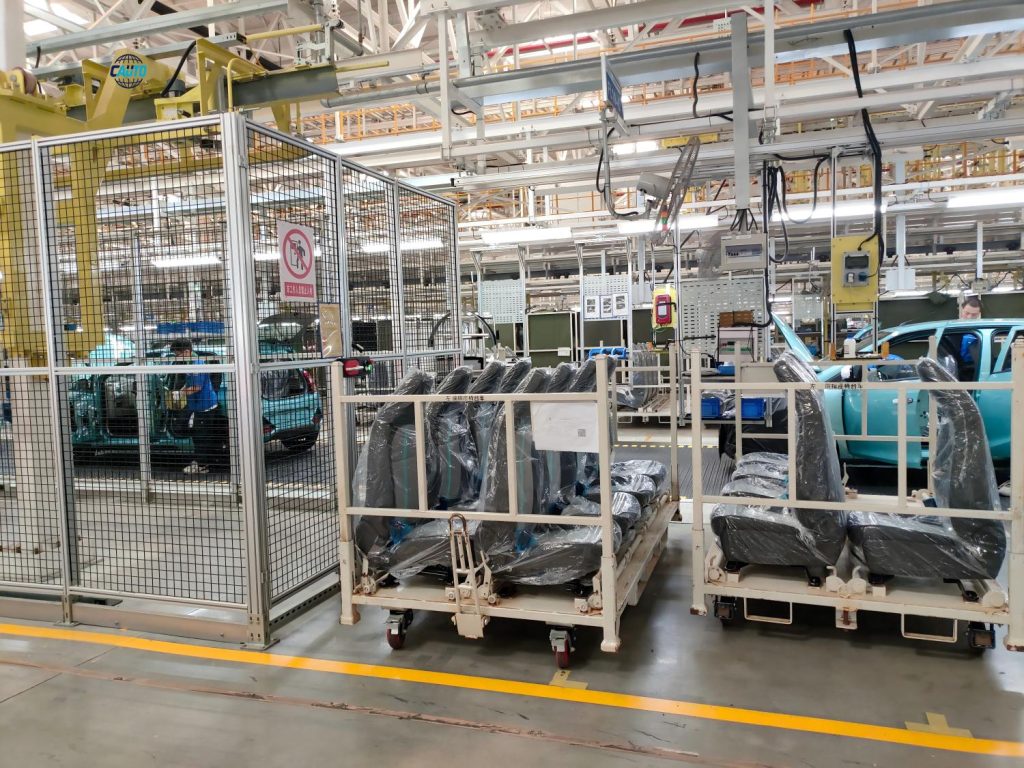
What Is Car Production Machinery?
Car production machinery refers to the specialized equipment, automated systems, and integrated manufacturing lines used to transform raw materials and components into finished vehicles. This machinery spans the entire automotive production process—from stamping sheet metal into body panels, welding chassis structures, applying corrosion-resistant paint coatings, assembling powertrains and interiors, to conducting final quality validation before vehicles leave the factory floor.
For emerging automotive markets such as Iraq, car production machinery represents more than manufacturing tools; it is the foundation of industrial sovereignty. Iraq’s vehicle market reached approximately 160,737 units in 2025, with Kia claiming 28% market share and Toyota at 20.7% following years of post-conflict recovery and 28.8% growth in 2024.
Yet the country remains heavily import-dependent, with the government actively pursuing “Made in Iraq” initiatives to localize assembly and reduce reliance on fully built unit (FBU) imports.
Key Types of Car Production Machinery
Modern automotive manufacturing relies on five core production zones, each requiring distinct machinery configurations optimized for throughput, precision, and flexibility.
1. Stamping Press Lines
Stamping machinery forms the structural skeleton of every vehicle. Mechanical and hydraulic presses ranging from 600 to 5,000 tons force flat steel coils into complex 3D body panels, floor pans, and door assemblies. Progressive die systems and transfer presses enable high-volume production at rates exceeding 15 strokes per minute for popular models.
For markets like Iraq—where the Kia Frontier pickup and Toyota Hilux dominate sales—stamping lines must accommodate both passenger car and light commercial vehicle (LCV) body variants within the same facility. This flexibility is critical when a single assembly plant targets multiple segments, from urban SUVs to rugged field vehicles.
2. Welding and Body Assembly Robotics
The body shop represents the highest automation density in vehicle manufacturing. Welding robots—predominantly articulated six-axis arms from KUKA (KR QUANTEC series), ABB (IRB 6700), and Fanuc—execute spot welding, arc welding, and laser welding operations with repeatability精度 of ±0.05mm.
Iraq’s state-owned automotive manufacturer recently assembled its first batch of 360 Kia single-cabin field vehicles at a Babylon facility, with Iraqi workers executing body assembly, technical inspection, and quality testing phases—a milestone in the country’s industrial reconstruction.
Such projects demonstrate how modular welding jigs and semi-automated body assembly lines can enable developing nations to establish credible manufacturing capabilities without requiring full robotic automation from day one.
3. Paint Shop Equipment
Automotive paint shop machinery constitutes one of the most capital-intensive production zones. The process encompasses electrocoating (E-coat) immersion tanks, sealant application robots, primer and base coat spray booths, and clear coat curing ovens. Environmental compliance requires integrated VOC abatement systems and wastewater treatment infrastructure.
Dürr EcoRP series robotic spray applicators have become the industry standard for high-efficiency painting, reducing material waste by 15–20% compared to manual spray operations while ensuring uniform film thickness across complex vehicle geometries. For emerging markets prioritizing cost efficiency, compact paint shop designs with reduced booth volumes and energy-recovery systems offer viable entry points without compromising quality standards.
4. Final Assembly Lines
Vehicle assembly machinery integrates the painted body with powertrain, chassis, interior, and electrical systems. Modern assembly lines employ automated guided vehicles (AGVs), overhead conveyor systems, and ergonomic lifting assists to optimize operator efficiency and reduce physical strain.
The Middle East vehicle manufacturing market—valued at USD 28–35 billion in 2026 with 4.5–6.0% projected CAGR through 2035—relies heavily on CKD/SKD assembly models, with 70–80% of locally produced vehicles using knock-down kits from global OEMs.
This approach minimizes capital expenditure while enabling localized customization and import tariff reduction. Iraq’s 2024 launch of Basra assembly plants with 20,000-unit annual capacity exemplifies this strategy, targeting passenger car and commercial vehicle segments to foster domestic production and employment.
5. End-of-Line Testing and Validation
Quality assurance machinery includes wheel alignment stations, headlight aiming systems, brake test benches, rain simulation booths, and chassis dynamometers. These systems verify that every vehicle meets safety, emissions, and performance specifications before market release.
How to Choose the Right Car Production Machinery
Selecting appropriate car production machinery requires balancing technical requirements, capital constraints, and strategic objectives. Decision-makers in emerging markets should evaluate four critical dimensions:
Production Volume and JPH Targets: Jobs Per Hour (JPH) defines line speed and equipment sizing. A 15 JPH assembly line suits initial market entry with 10,000–20,000 annual units, while 30+ JPH configurations support scaled operations exceeding 50,000 units.
Vehicle Mix Flexibility: Multi-platform compatibility enables a single facility to assemble sedans, SUVs, pickups, and eventually electric vehicles (EVs). Iraq’s EV market surged 28.8% in 2025, though still representing only 2% of total sales—suggesting near-term demand for ICE-compatible lines with EV-ready electrical infrastructure.
Localization Requirements: CKD/SKD operations require less sophisticated machinery than full integrated manufacturing but demand precise kit sequencing, quality control protocols, and technical training systems. The “Made in Iraq” strategy specifically targets gas-powered vehicles for lower-income citizens with installment payment options, influencing machinery specifications toward cost-optimized, durable configurations.
Supplier Ecosystem and After-Sales Support: Machinery downtime in remote locations can halt production for weeks. Partner selection must prioritize suppliers with regional service networks, spare parts availability, and remote diagnostic capabilities.
Why Source Car Production Machinery from China?
China has emerged as the world’s largest exporter of automotive production equipment, offering distinct advantages for developing markets:
Integrated Supply Chain: Chinese manufacturers provide complete turnkey solutions—from stamping dies and welding fixtures to paint shop integration and assembly line commissioning—under single-contract accountability. This eliminates the complexity of coordinating multiple European, Japanese, and American vendors.
Cost Efficiency Without Quality Compromise: Chinese car production machinery typically delivers 30–40% capital expenditure savings compared to Western equivalents, while meeting ISO and CE certification standards. For budget-constrained markets like Iraq, where fiscal deficits reached 7.5% of GDP in 2025,
this cost advantage accelerates project viability.
CKD/SKD Expertise: Chinese suppliers have extensive experience configuring assembly lines for knock-down kit operations across Africa, Southeast Asia, and the Middle East. This includes optimized container loading schemes, simplified assembly sequences for lower-skilled workforces, and modular line designs that expand with demand growth.
EV Transition Readiness: As the global automotive industry pivots toward electrification, Chinese machinery suppliers lead in battery pack assembly lines, electric motor testing equipment, and EV-specific body shop configurations—future-proofing investments for markets where EV adoption will eventually accelerate.
CAUTO: Your Turnkey Partner for Car Production Machinery
China Automotive Global Supply Chain Co., Limited (CAUTO) specializes in the complete export of car production machinery and turnkey automotive assembly lines to emerging markets worldwide.
Our integrated solutions cover every production zone: stamping press lines, robotic welding shops, Dürr-compatible paint shop equipment, flexible final assembly systems, and end-of-line validation stations. We support CKD, SKD, and OEM manufacturing modes, enabling clients to establish local vehicle assembly with optimized capital deployment.
CAUTO has actively supported automotive industrialization initiatives across the Middle East, Africa, and Southeast Asia. Our technical teams provide on-site installation supervision, operator training programs, and long-term spare parts logistics—ensuring your car production machinery operates at designed efficiency from day one.
Whether you are launching a 20,000-unit annual assembly facility or scaling toward 100,000+ units, CAUTO delivers scalable, future-ready manufacturing infrastructure tailored to your market’s regulatory environment, labor skill levels, and product mix requirements.
FAQ: Car Production Machinery for Emerging Markets
Q: What is the minimum investment for a CKD car assembly line? A: A basic CKD assembly facility with 10,000–15,000 unit annual capacity typically requires USD 5–15 million in machinery and infrastructure, depending on automation level and vehicle complexity. Semi-automated configurations reduce initial capital while maintaining quality consistency.
Q: How long does it take to commission a complete car production line? A: From contract signature to first vehicle rollout, turnkey projects typically span 12–18 months. This includes equipment manufacturing, shipping, installation, commissioning, trial production, and operator certification phases.
Q: Can existing ICE assembly lines be retrofitted for EV production? A: Yes. Body shop and paint shop machinery largely remains compatible. Primary modifications involve battery pack assembly stations, electric powertrain marriage lines, and high-voltage safety testing equipment. CAUTO designs lines with EV-upgrade pathways to protect long-term investments.
Q: What training is required for local workers to operate car production machinery? A: Basic assembly operations require 2–4 weeks of supervised training. Welding robot programming, paint shop process control, and quality systems management require 3–6 months of technical certification. CAUTO includes comprehensive training protocols in every project scope.
Building Iraq's Automotive Future, One Line at a TimeCar production machinery is the critical enabler of automotive industrialization in emerging economies. For Iraq and similar markets transitioning from import dependency to localized manufacturing, strategic equipment selection—prioritizing CKD/SKD flexibility, scalable automation, and supplier reliability—determines long-term competitiveness.
As Iraq advances its “Made in Iraq” initiative with new assembly partnerships involving German, Chinese, and Brazilian automakers,
the demand for proven, cost-effective car production machinery will intensify across the Middle East.
Ready to establish your automotive manufacturing capability? Contact CAUTO today to discuss your project requirements, receive a customized machinery quotation, or schedule a virtual factory tour of our reference installations.